Through the Jungle
I. Arrival
The path narrows gradually, swallowed by thick undergrowth. Leaves pile underfoot, wet and heavy, and roots rise like the ribs of the forest itself, twisting across the soil in long, deliberate curves. Light falls in fragments through the canopy, slanting across moss and broken branches, catching the edges of stones that the jungle has partially claimed. Every patch of brightness appears briefly, then disappears as the leaves shift with a slow, patient wind. The air is dense with smell—earth, wet leaves, and something faintly sweet, a scent that seems to belong neither to the ground nor the sky, like flowers opening somewhere unseen. The forest breathes around you, not moving, not pressing, but holding its own rhythms and letting yours slow.
Small pools of water gather in dips where the ground falls away, reflecting shards of sky and the deep green of surrounding ferns. Insects hum, their pulses irregular, weaving a quiet, textured soundtrack that blends with the occasional call of a distant bird. Somewhere in the undergrowth, something shifts. Pause. A rustle. Then stillness returns. Each step draws you deeper, the sounds folding and layering like soft curtains around you. Moss clings to rocks and roots, softening the edges of shapes that are older than memory, shapes that might have been carved or might have simply grown into place over centuries.
Old trunks rise thick and straight, bark grooved with shadow, and vines climb toward light in slow spirals. The forest is dense, but the space around you feels deliberate, as though it has been clearing a path for centuries, not for you, but for what waits ahead. Stone begins to appear at the edges of vision—flat slabs half-buried, corners softened by moss, hints of walls beneath layers of plant life. The jungle does not yield these forms. It frames them, folds them into its mass, integrates them into the rhythm of growth, making the ancient and the living inseparable.
The ground slopes downward, the forest floor darkening under heavier canopy. The air grows cooler and more still. The hum of insects thins, leaving space for a low, steady quiet. The light shifts subtly, revealing the first clear outlines of stone, almost hidden, almost secret. Movement carries you forward. The forest does not announce what lies ahead, only suggests it, a shadow between trees, a line that does not belong to nature, a presence older than memory. Time stretches. Your steps are measured. The path continues, waiting. And the jungle exhales around you, letting you arrive, letting you notice, letting the world hold its breath before the temple appears.
II. The Passage Through
The forest shifts as you move deeper. Trees grow closer together, their trunks wider and older, bark etched with long grooves that capture shadow even in midday light. Vines spiral upward, thick and thin, twisting around branches, looping down, and returning to the earth. Some hang like curtains, parting only when you pass beneath, brushing your shoulders with damp green. The air carries a faint vibration, a hum of insects layered like a hidden chorus, rhythm irregular and slow, almost imperceptible. Somewhere a small stream moves over stones, unseen but constant, its soft murmur filling gaps in the soundscape.
The undergrowth thickens. Ferns brush against your legs, their fronds cool and delicate. Roots rise into arches, cross the path, twist back into the soil as if the ground itself is shaping a route through the jungle. Stone begins to appear more clearly. A fragment here, a slab there, edges softened by moss and time. The shapes are subtle, almost accidental, but their lines are deliberate, drawing the eye in ways the forest itself cannot explain. The jungle does not relinquish them willingly. It folds them into its green, threads them through every vine, every leaf, every tendril.
The light changes. The canopy thickens, and the air grows cooler. Sunlight hits surfaces in sharp, fleeting patches, illuminating details that disappear as soon as you notice them. Moss glows faintly where it clings to stone. Water collects in shallow basins on uneven rock, still and dark. The sounds thin, the insect chorus retreating, replaced by quiet murmurs and distant calls. The forest seems to shift aside just enough, creating a narrow corridor lined with trees, vines, and occasional hints of stone, a deliberate path formed without human hand.
Every step feels measured. The path carries you downward, and shadows lengthen. The stone fragments are now more frequent, more organized, suggesting walls beneath the foliage. The shapes are not obvious yet, but the mind begins to recognize them as deliberate, not accidental. The air grows cooler and stiller, holding a weight that is neither oppressive nor forbidding. It waits. It waits for what is ahead. The jungle exhales around you, folding its sounds, scents, and light into a soft, rhythmic anticipation. You move forward, pulled by curiosity, carried by quiet, and held by the forest itself.
III. First Sight
The trees thin just enough to open the view. At first, it is only a hint: a line not quite natural, a shadow that moves differently than leaves. Stone. Light strikes it briefly, and then it is gone behind a cluster of vines. The forest exhales, giving space for something older to emerge.
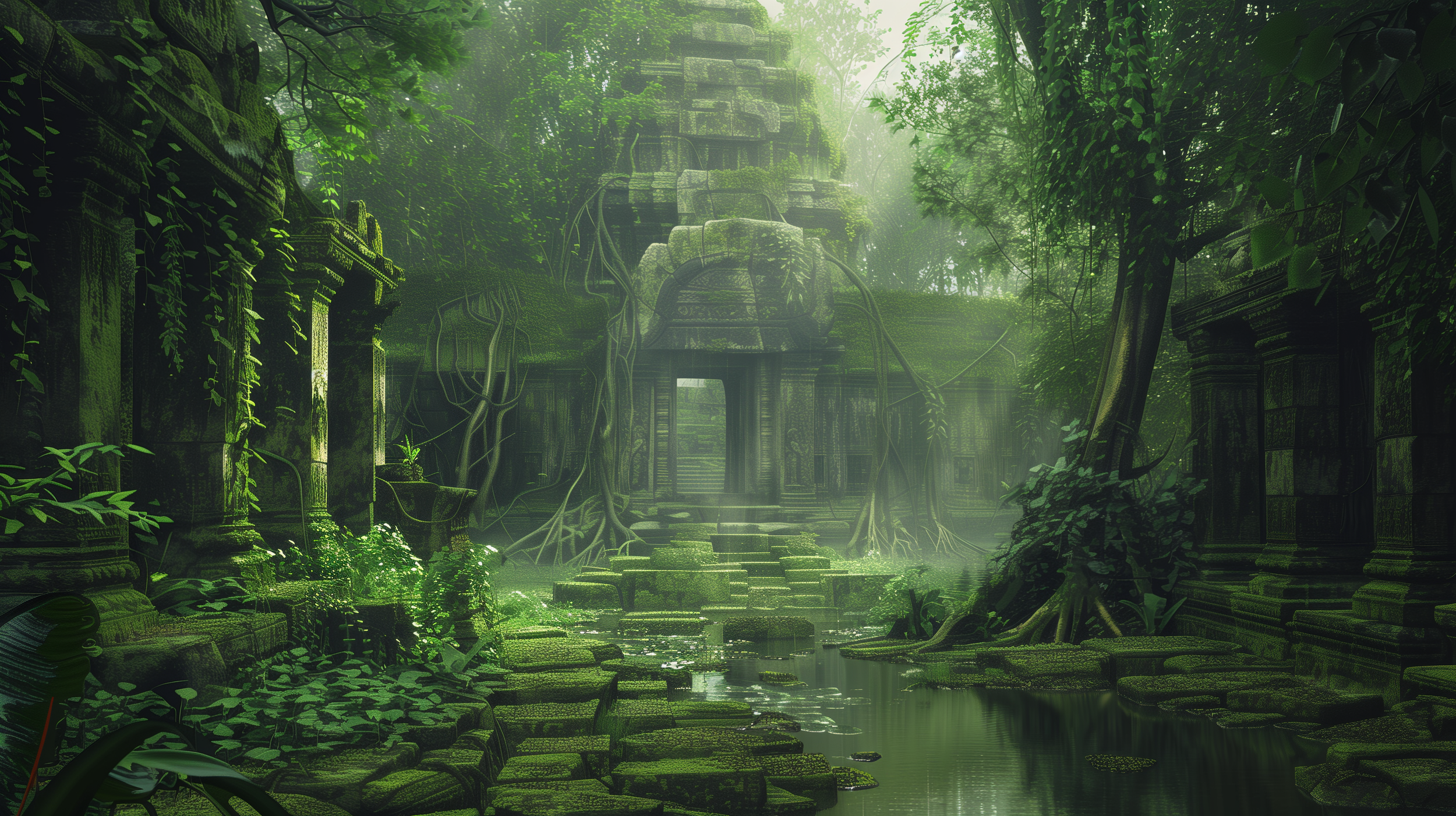
Then the temple becomes visible. Its towers rise through the canopy, worn and softened by centuries. Moss clings to every corner. Vines twist around pillars and along terraces, claiming the stone without destroying it. The building feels complete, not abandoned, as if the jungle has always been its setting, not its conqueror. Light plays along carved surfaces, highlighting edges and reliefs that have long lost their original meaning but retain rhythm and texture.
The scale is slow to reveal itself. A single tower appears, then another. Terraces and stairways, partially hidden by foliage, suggest layers of space and history. Shadows fall deep and cool across stone that has endured time, water, and wind. Pools of water collect on flat surfaces, reflecting fragments of sky and the green of the forest. Movement within the trees is muted; a bird lifts, its wings stirring the air, then silence returns.
The air changes. It cools subtly, moving in long, slow drafts through the forest openings. Sounds from the deeper jungle fade, leaving a hushed quiet that frames the temple. There is no announcement, no fanfare, only presence. The stone towers do not demand attention. They allow it, holding the gaze without effort. You pause at the edge of the clearing, taking in the lines, the textures, the interplay of shadow and light. Every detail is intentional yet untouched. Time seems to slow, as if the forest itself is holding its breath for the temple to be seen.
IV. Entering the Temple
The entrance is narrow, framed by stone softened by time. Vines hang loosely, brushing your skin as you step through, their dampness cool against your hands. The outside world falls away immediately. Light dims, shifting from the bright fragments of the canopy to a muted, filtered glow. The air is cooler, denser, still. It carries the smell of stone and damp earth, faint and steady, and every sound seems drawn inward. Footsteps soften, echoing against walls that have held silence for centuries.
Inside, the space expands gradually. A high ceiling opens overhead, far above where sunlight filters in thin shafts, illuminating dust motes drifting slowly through the air. The stone walls rise around you, marked by worn carvings and patterns softened by moss and time. The details are faint, but their rhythm is clear: lines that lead the eye upward, across chambers, into shadowed corners where light does not reach.
Pools of water collect on the floor, perfectly still. They reflect the muted light, doubling the effect of the air’s coolness and the dark stone around them. Every step disturbs the silence only slightly, the sound absorbed by centuries of stone and leaf. Shadows stretch and deepen. There is no hurry. There is nothing to do. The temple exists in its own tempo, and you adjust to it without effort.
The air itself feels heavier here, yet breathable. Each inhale draws in the quiet. Each exhale releases the tension you did not realize you carried. Light fades gradually, not abruptly, as you move deeper. The temple holds you. You notice the texture of the walls under your fingertips, the subtle curve of a stone step, the soft ripple of water in its basin. You stop. There is nowhere to go but stillness. Time loosens completely. Outside, the jungle continues, alive and patient. Inside, the temple waits, and you are here, quietly held by its presence.