Fall Asleep on a Volcanic Island
A cinematic sleep story shaped by fire, earth, and silence to help you fall into deep rest beneath a distant volcanic sky.
Falling asleep is rarely about forcing the mind to switch off. More often, it is about giving attention something steady enough to rest upon. A landscape that moves slowly. A rhythm that does not demand reaction. A presence that feels grounding rather than stimulating.
The Volcanic Island — A Sleep Story with ÆRTHIA was created as a cinematic sleep story for adults who struggle to unwind at night. Designed for deep relaxation and insomnia relief, it guides you gently through an elemental landscape shaped by ocean, jungle, and fire, allowing the nervous system to settle naturally.
The journey begins far from land, drifting across open water at dusk. The sea moves in long, patient rhythms. The sky darkens gradually. The steady motion of the boat becomes a calming anchor, helping the body shift away from the mental pace of the day. This slow arrival is intentional. There is no sudden change of scene, no urgency, only gradual immersion.
As the volcanic island rises into view, its silhouette feels ancient and grounding. Jungle climbs from black sand beaches. The volcano stands quietly at the center, steady rather than dramatic. When you step onto the shore, sensory detail replaces thought. The texture of warm sand. The scent of salt and mineral earth. The distant sound of water folding into itself. Each element works together to create a guided sleep journey that draws awareness into the body instead of the mind.
The ascent through dense jungle and lava stone continues the process of unwinding. Steam drifts from hidden vents. Temperature shifts gently. Sounds become softer and more contained. The narration slows with the climb, allowing breath to deepen and muscles to release. This is not a bedtime story built around plot twists or character arcs. It is a relaxation story shaped by atmosphere and rhythm.
At the crater’s edge, a faint red glow reflects through drifting vapor. Heat gathers without intensity. The earth feels alive but calm. The environment holds warmth, depth, and quiet movement beneath the surface. Here, the pacing becomes even slower, encouraging deep sleep by widening the spaces between words and softening the cadence of the voice.
The final phase of the story is designed specifically for falling asleep fast. Mist thickens gradually. Light fades slowly. The volcanic glow softens into darkness. Rather than ending abruptly, the landscape dissolves gently, mirroring the natural descent into sleep. This extended settling phase allows the mind to drift without disruption.
For listeners who experience racing thoughts at night, restless sleep, or difficulty switching off, this immersive sleep story offers a steady sensory anchor. The combination of elemental imagery, calming narration, and slow atmospheric pacing helps create the conditions for deep rest without effort.
Aerthia is built on the belief that sleep arrives when the environment feels safe and grounded. The volcanic island becomes that environment — a place where ocean, jungle, and earth move in harmony, and where the body can soften naturally into the night.
Listen to The Volcanic Island — A Sleep Story with ÆRTHIA on YouTube and allow the journey to carry you toward deep, uninterrupted sleep.
The Path Above the Clouds
A slow ascent through mountain silence toward a temple beyond the clouds.
There are places that do not announce themselves loudly. They exist quietly, waiting somewhere beyond the edge of familiar movement, revealed only when pace slows enough for them to be noticed.
Our latest Sleep Story The Mountain Temple Above the Clouds begins in that space between motion and stillness. Not with urgency, but with arrival. The world below fades gradually as a narrow path climbs through layers of mist and stone, leading toward a temple that seems less discovered than remembered.
Evening settles gently over the mountains. The last light rests along distant ridgelines while shadows deepen across the valley floor. Wind moves softly through pine and prayer flags, carrying the faint suggestion of incense that lingers without source. Nothing here demands attention. Everything exists in quiet continuity.
The journey unfolds slowly, almost imperceptibly. Footsteps find their own rhythm along worn stone. Clouds drift across the path and dissolve again. Sound becomes sparse, leaving space between moments where breath and awareness begin to align without effort. Rather than guiding you forward, the mountain allows you to slow until movement feels natural again.
This sleep story is not built around destination or resolution. Instead, it offers atmosphere — a landscape designed to hold the listener gently as the day releases its grip. The temple itself appears gradually through mist, integrated into the cliffside as though it has grown from the mountain rather than been built upon it. Light glows softly from within, suggesting presence without interruption.
In this space, sleep is not something pursued directly. It arrives as a consequence of quiet attention. The mind, given a continuous and gentle environment, begins to loosen its patterns. Thoughts stretch and fade like clouds passing across the peaks. The story continues whether followed closely or only half-heard, allowing rest to emerge naturally rather than through effort.
There is something deeply grounding about landscapes that exist beyond urgency. Mountains do not hurry. Mist does not force direction. Time expands when nothing demands conclusion. Within this slow unfolding, the listener is invited to inhabit a different rhythm — one where presence replaces productivity, and silence becomes a form of comfort rather than absence.
The Mountain Temple Above the Clouds is an offering of that rhythm. A place shaped not by instruction but by atmosphere. A quiet ascent toward stillness where the night deepens gently and the world feels held rather than distant.
If you choose to listen, allow the story to move at its own pace. Let the path reveal itself slowly. Let the mountain hold the rest.
Listen to the full sleep story on YouTube.
Crossing into the Quiet
A bridge hidden in rain and mist becomes a passage into quiet.
There are places that do not appear on maps.
Not because they are hidden deliberately, but because they exist in a different rhythm from the world around us. They are not destinations you arrive at quickly or intentionally. They reveal themselves slowly, often at the edge of exhaustion, at the moment when noise begins to fall away and attention softens.
Our newest sleep story, The Hidden Jungle Bridge, begins in such a place.
You enter the jungle at dusk, when the air grows heavy with warmth and the first layers of mist begin to settle beneath the canopy. Rain falls gently but constantly, threading through leaves and branches, softening every surface. There is no clear path forward. Only instinct guides you deeper, through dense foliage and shifting shadows, toward something half-imagined and half-remembered.
Somewhere ahead lies a bridge.
Old. Narrow. Suspended high above a wide jungle river that moves slowly through the darkness below. No one speaks of it with certainty. It is felt more than known — a quiet presence hidden within the vastness of the forest. And yet something within you continues forward, drawn by the subtle promise of crossing.
This sleep story unfolds slowly, like the jungle itself. The search becomes part of the experience. The air thickens with humidity. Distant birds call through the trees. Rain becomes the only rhythm that matters. As the bridge finally emerges from the mist, the journey changes, shifting from discovery into surrender.
Each step across the ancient planks is careful, deliberate.
Wood creaks softly beneath your feet. Gaps between boards reveal glimpses of the river far below, moving endlessly beneath layers of rain and shadow. The bridge stretches forward into the mist, disappearing into a horizon that never fully reveals itself.
Nothing rushes. Nothing demands attention.
The story moves at the pace of breath, inviting you to walk slowly, to notice without effort, and eventually to release the need to reach the other side at all.
Sleep stories are not meant to be followed perfectly. They are meant to be entered. You may listen closely, imagining every detail of the jungle around you. Or you may drift away midway across the bridge, carried by the sound of rain and the steady rhythm of movement. Both are welcome. Both are part of the journey.
Within ÆRTHIA, stories are not simply narratives. They are spaces. Environments shaped by atmosphere rather than urgency. Places where you can rest without needing to arrive anywhere.
The Hidden Jungle Bridge exists as one of these spaces. A crossing between worlds. Between wakefulness and sleep. Between the familiar and the unknown. If you feel drawn to step into it, you can listen to the full sleep story now on YouTube.
Let the rain guide you forward. Let the bridge carry you the rest of the way.
When Attention is No Longer Forced
Observing the quiet ways attention moves when effort falls away.
There is a particular quality to attention in our daily lives, a way it moves through us without pause, shifting from one thing to the next, rarely allowed to rest. Sounds, notifications, subtle cues, and the demands of routine create a constant undercurrent, a soft pressure that pulls awareness forward even when we do not consciously consent. Over time, moving in this way begins to feel natural, almost expected, as though attention itself were meant to remain in motion rather than to settle.
The fatigue that comes with this constant motion is quiet but persistent. It does not appear dramatically or announce itself as crisis. Instead, it shows as a low tension in the body, a subtle tightness that rarely fully releases. Moments that could be restful carry the expectation of usefulness. To pause feels permissible only if it leads somewhere. To listen feels valuable only if it produces insight. Presence itself begins to feel conditional.
Gradually, attention comes to feel like labor. It is something to manage, to conserve, and to repair when it falters. Language reflects this shift. We speak about attention as though it is spent or lost, something that must be reclaimed through effort. Even stillness is framed as preparation, a temporary pause meant to restore capacity before returning to the next demand. Drifting feels like failure rather than a natural movement of awareness.
Spaces without instruction or expectation can feel unexpectedly disorienting. Places where nothing asks for response, where there is no clear indication of how long to stay or what to notice. At first, the absence of direction produces restlessness. The mind searches for orientation and waits for permission to relax. Stillness feels provisional, as though it must justify itself.
If that waiting is allowed to continue, something subtle begins to shift. Attention loosens without effort. It becomes less narrow, less insistent, less oriented toward outcome. Perception widens gradually. Sound is experienced as texture rather than signal. Darkness is felt as depth rather than emptiness. Time does not stop, but it softens, stretching gently as the body settles into a slower rhythm.
In these moments, attention behaves differently. It is no longer pulled forward by novelty or demand. Awareness moves into the body, into the sensation of sound unfolding in darkness, into the feeling of standing among stone, water, air, or shadow. Attention is inhabited rather than directed, held gently rather than aimed.
The elements provide quiet orientation. Earth does not hurry or adapt to expectation. Water moves at its own pace, indifferent to interpretation. Fire provides warmth and light without explanation. Air shifts continuously without purpose. These presences do not reward concentration or punish distraction. They persist regardless. In their company, attention can wander without becoming lost and rest without becoming inert.
What emerges in this state is not clarity in the conventional sense. There is no revelation waiting to be articulated, no insight demanding translation. Instead, there is a sense of being inside experience rather than observing it from a distance. The body registers before the mind names. Perception slows enough to notice small variations: the density of silence, the cadence of distant sound, the way darkness shifts as the eyes adjust.
This form of attention does not accumulate or progress. It does not build toward mastery or leave behind a measurable trace. And yet it remains. Not as a lesson, but as familiarity. A quiet recognition that awareness can exist without being driven, that presence does not require effort.
These moments of stillness are not reached once and left behind. They are returned to. Not because they provide answers, but because they offer conditions. A reminder that attention does not always need to be activated or defended. That time can soften when nothing is trying to claim it.
In a world where so much competes for the foreground, these quiet returns matter. They do not reject modern life, but they loosen its hold. They create room for attention to become something other than labor, something closer to listening, closer to inhabiting, closer to simply being.
When attention is no longer forced, it does not disappear. It changes character. It becomes less about control and more about contact, less about focus and more about presence. Within that shift, there is no instruction and no urgency. Only the experience of being here, for as long as it feels right.
Descending Into Stillness
A sleep story shaped by depth, darkness, and the quiet patience of the sea.
Night does not always arrive all at once.
Sometimes it lowers itself gently, like a tide pulling away from the shore.
Our latest sleep story is an invitation into that kind of night.
It begins far above the surface, where a boat drifts on open water beneath a darkened sky. The air is cool. The sea is calm but vast, holding its depth without revealing it. Nothing is rushed. Nothing is demanded. From there, the story slowly descends, moving away from the noise of the world and the familiar markers of time and place, and into a deep underwater valley where stillness takes on a different meaning.
This is not a story driven by plot or urgency.
It is a story shaped by atmosphere.
As the descent continues, light thins and sound softens. The surface becomes a memory rather than a presence. Strange marine life glides through the water, not dramatic or threatening, simply existing in a rhythm untouched by the world above. The deeper you move, the more the mind begins to release its grip, mirroring the slow surrender of the journey itself.
Sleep stories work best when they do not ask you to imagine too much or follow too closely. This one is designed to carry you gently, allowing the images to unfold on their own while your attention drifts in and out. You may follow every word. You may lose the thread entirely. Both are welcome.
At its core, this story is about depth, not just of place, but of rest. It is about the quiet that exists far below distraction, where time stretches and thought loosens. It is about allowing yourself to move away from the surface of things, even for a single night.
If you are carrying the weight of the day, if your thoughts feel restless, or if sleep has been slow to arrive, this story offers a different kind of entry into rest, one shaped by patience, darkness, and the vast calm of the unseen world below.
You can listen to the full sleep story now on YouTube.
Let it play softly. Let the night do the rest.
Journey to a Hidden Temple
A temple reclaimed by nature, waiting not to be found, but to be felt.
There are places the world has forgotten.
Not because they were unimportant, but because nature slowly, patiently reclaimed them. Stone softened by moss. Pathways erased by rain. Walls held together not by mortar, but by roots and time.
The latest meditation from ÆRTHIA begins at the edge of one of those places.
A jungle, dense and alive, breathes around you. The air is heavy with moisture. Leaves brush past your skin. Light filters down in fragments, never fully arriving, never fully leaving. With each step, the outside world loosens its grip. Sound changes. Time softens. Attention narrows until there is only movement, breath, and presence.
This is not a meditation about arriving quickly.
It is about moving slowly through something vast and ancient. About letting the mind follow the rhythm of the jungle rather than trying to control it. About allowing the path to reveal itself only when you are ready to notice it.
Somewhere deeper within the forest, a structure waits. Not hidden by intention, but by time. Stone wrapped in roots. Carvings worn smooth by rain. A temple no longer separate from the land that surrounds it.
In this guided jungle meditation, the temple is not a destination to conquer or explore. It is a place to rest your awareness. A reminder that stillness does not need to be created — it already exists, beneath the noise, beneath the effort, beneath the need to arrive.
The only sound throughout the journey is rain. Falling steadily. Without urgency. Without pause. A constant presence that allows the body to settle and the mind to drift without distraction.
This meditation was created to be experienced slowly. With headphones, if possible. With no expectation of outcome. You don’t need to visualise perfectly. You don’t need to follow every word. You only need to let the journey unfold at its own pace.
If you’ve been craving something quieter than productivity, softer than motivation, and deeper than relaxation, this journey is waiting for you.
You can listen to Journey to a Hidden Temple — A Guided Jungle Meditation with ÆRTHIA now on YouTube.
Step inside when you’re ready.
The Cabin in the Forest
A slow journey through rain and forest toward warmth and stillness.
There are nights when the world feels too loud, even in silence.
Thoughts linger longer than they should. The day replays itself in fragments. Rest feels close, but just out of reach.
This is where The Cabin in the Forest begins.
Not with urgency.
Not with instruction.
But with rain.
Rain falling softly through trees.
A forest at night, breathing in its own rhythm.
The kind of place where nothing is asking for your attention, and nothing needs to be understood.
The journey moves slowly. There is no destination to reach, no moment to anticipate. You walk beneath branches heavy with moisture, the ground yielding gently beneath each step. The forest doesn’t guide you forward — it simply surrounds you, steady and patient.
Somewhere ahead, a warm light exists.
Not bright.
Not calling.
Just present.
The cabin appears as if it has always been there. Nestled among trees. Protected by rain. Firelight glowing quietly inside. A place reclaimed by the forest rather than carved from it.
Inside, the world softens.
The voice becomes slower, gentler, and eventually fades away, leaving only rain and fire to remain with you. Nothing pulls you back. Nothing interrupts. The night continues on its own terms.
This sleep story was created as a place to rest — not escape. A reminder that stillness doesn’t need to be earned, and sleep doesn’t need to be forced. Sometimes, the body only needs permission to stop holding the day.
The Cabin in the Forest is now available on YouTube as part of the growing ÆRTHIA collection of calm sleep stories and immersive journeys.
If you feel drawn to it, let yourself listen.
Not to arrive anywhere.
But to settle, quietly, into the night.
Watch: The Cabin in the Forest — A Calm Sleep Story with Rain & Firelight (Available now on the ÆRTHIA YouTube channel)
The Forest after the Rain
The rain has passed, the earth is heavy. Everything slows in place.
The rain has already passed through the forest, but it has not yet left it. What remains is a state of holding. Water rests where it landed, gathered into the seams and surfaces of things, darkening them, weighting them, asking nothing of the hours that follow. The forest is quieter now, though not in the sense of emptiness. It is quiet the way something becomes when it is full.
The path at the edge of the trees is altered, its familiar outline softened by mud and standing water. The ground yields slightly as you step onto it, not enough to slow you, but enough to register. Each footfall presses into the surface and stays there, the earth slow to forget the shape of what has passed over it. The air is cool and dense, carrying the scent of wet bark, iron-rich soil, and leaves beginning to break down under their own weight. Breathing feels different here, less like drawing something in and more like moving within something already present.
Above you, water releases itself from the canopy in no particular order. Drops fall from the tips of leaves, from needles, from the undersides of branches, striking stone, wood, and earth before disappearing again. There is no rhythm to follow, no pattern that settles into predictability. Sound arrives and leaves without building toward anything, absorbed quickly by the softened ground and the thickened air.
Deeper in, the forest shows the marks of saturation everywhere. Moss glows with a darker intensity, its surface swollen and luminous. Leaves cling together in heavy clusters, their edges blurred, their colors deepened beyond what they held before the rain. The trunks of trees appear sealed and slick, reflecting small fragments of light that slide across them and vanish. Everything looks slightly enlarged, as if the forest has taken on more substance, more weight than usual, and is adjusting slowly to the change.
Water continues its quiet movement through the landscape. It travels downward along grooves in bark and between roots, collecting in shallow depressions where it pauses without decision. Small pools form and remain, mirrors clouded by sediment and shadow. The forest does not rush to drain itself. It absorbs, redistributes, and waits. Time feels stretched here, not suspended, but unconcerned with pace.
As you move, the ground asks for attention. The softened soil gives beneath your steps, requiring small adjustments in balance. Fallen branches press more firmly into the earth, their outlines softened by moisture. Nothing here resists your presence, but nothing responds to it either. The forest is engaged in its own processes, continuing work that began before you arrived and will continue long after you leave.
Somewhere beyond sight, a branch shifts and settles, releasing water it no longer holds. The sound is brief and unremarkable, one of many small changes happening without audience or meaning. Light filters through the canopy in muted fragments, never fully gathering, never staying in one place long enough to claim it. There are no clear edges, no bright clearings that suggest arrival. Only gradual variation, one condition easing into the next.
As you pass through, the impressions you leave are minimal and temporary. Footprints soften at their edges. Disturbed water grows still again. The forest registers these changes briefly, then returns its attention inward, to soil compacting, leaves separating, water continuing its slow descent through layers of earth and root.
By the time the path widens and the ground firms again, the forest behind you has already begun to settle into what follows rain. Not a return to what it was, but a quiet movement toward whatever comes next. Moisture held, weight redistributed, surfaces darkened and slowly drying in their own time.
The rain has moved on.
The forest remains, altered and patient, still in the middle of becoming.
Through the Jungle
A meditative immersion into the jungle to slow, centre, and restore.
I. Arrival
The path narrows gradually, swallowed by thick undergrowth. Leaves pile underfoot, wet and heavy, and roots rise like the ribs of the forest itself, twisting across the soil in long, deliberate curves. Light falls in fragments through the canopy, slanting across moss and broken branches, catching the edges of stones that the jungle has partially claimed. Every patch of brightness appears briefly, then disappears as the leaves shift with a slow, patient wind. The air is dense with smell—earth, wet leaves, and something faintly sweet, a scent that seems to belong neither to the ground nor the sky, like flowers opening somewhere unseen. The forest breathes around you, not moving, not pressing, but holding its own rhythms and letting yours slow.
Small pools of water gather in dips where the ground falls away, reflecting shards of sky and the deep green of surrounding ferns. Insects hum, their pulses irregular, weaving a quiet, textured soundtrack that blends with the occasional call of a distant bird. Somewhere in the undergrowth, something shifts. Pause. A rustle. Then stillness returns. Each step draws you deeper, the sounds folding and layering like soft curtains around you. Moss clings to rocks and roots, softening the edges of shapes that are older than memory, shapes that might have been carved or might have simply grown into place over centuries.
Old trunks rise thick and straight, bark grooved with shadow, and vines climb toward light in slow spirals. The forest is dense, but the space around you feels deliberate, as though it has been clearing a path for centuries, not for you, but for what waits ahead. Stone begins to appear at the edges of vision—flat slabs half-buried, corners softened by moss, hints of walls beneath layers of plant life. The jungle does not yield these forms. It frames them, folds them into its mass, integrates them into the rhythm of growth, making the ancient and the living inseparable.
The ground slopes downward, the forest floor darkening under heavier canopy. The air grows cooler and more still. The hum of insects thins, leaving space for a low, steady quiet. The light shifts subtly, revealing the first clear outlines of stone, almost hidden, almost secret. Movement carries you forward. The forest does not announce what lies ahead, only suggests it, a shadow between trees, a line that does not belong to nature, a presence older than memory. Time stretches. Your steps are measured. The path continues, waiting. And the jungle exhales around you, letting you arrive, letting you notice, letting the world hold its breath before the temple appears.
II. The Passage Through
The forest shifts as you move deeper. Trees grow closer together, their trunks wider and older, bark etched with long grooves that capture shadow even in midday light. Vines spiral upward, thick and thin, twisting around branches, looping down, and returning to the earth. Some hang like curtains, parting only when you pass beneath, brushing your shoulders with damp green. The air carries a faint vibration, a hum of insects layered like a hidden chorus, rhythm irregular and slow, almost imperceptible. Somewhere a small stream moves over stones, unseen but constant, its soft murmur filling gaps in the soundscape.
The undergrowth thickens. Ferns brush against your legs, their fronds cool and delicate. Roots rise into arches, cross the path, twist back into the soil as if the ground itself is shaping a route through the jungle. Stone begins to appear more clearly. A fragment here, a slab there, edges softened by moss and time. The shapes are subtle, almost accidental, but their lines are deliberate, drawing the eye in ways the forest itself cannot explain. The jungle does not relinquish them willingly. It folds them into its green, threads them through every vine, every leaf, every tendril.
The light changes. The canopy thickens, and the air grows cooler. Sunlight hits surfaces in sharp, fleeting patches, illuminating details that disappear as soon as you notice them. Moss glows faintly where it clings to stone. Water collects in shallow basins on uneven rock, still and dark. The sounds thin, the insect chorus retreating, replaced by quiet murmurs and distant calls. The forest seems to shift aside just enough, creating a narrow corridor lined with trees, vines, and occasional hints of stone, a deliberate path formed without human hand.
Every step feels measured. The path carries you downward, and shadows lengthen. The stone fragments are now more frequent, more organized, suggesting walls beneath the foliage. The shapes are not obvious yet, but the mind begins to recognize them as deliberate, not accidental. The air grows cooler and stiller, holding a weight that is neither oppressive nor forbidding. It waits. It waits for what is ahead. The jungle exhales around you, folding its sounds, scents, and light into a soft, rhythmic anticipation. You move forward, pulled by curiosity, carried by quiet, and held by the forest itself.
III. First Sight
The trees thin just enough to open the view. At first, it is only a hint: a line not quite natural, a shadow that moves differently than leaves. Stone. Light strikes it briefly, and then it is gone behind a cluster of vines. The forest exhales, giving space for something older to emerge.
Then the temple becomes visible. Its towers rise through the canopy, worn and softened by centuries. Moss clings to every corner. Vines twist around pillars and along terraces, claiming the stone without destroying it. The building feels complete, not abandoned, as if the jungle has always been its setting, not its conqueror. Light plays along carved surfaces, highlighting edges and reliefs that have long lost their original meaning but retain rhythm and texture.
The scale is slow to reveal itself. A single tower appears, then another. Terraces and stairways, partially hidden by foliage, suggest layers of space and history. Shadows fall deep and cool across stone that has endured time, water, and wind. Pools of water collect on flat surfaces, reflecting fragments of sky and the green of the forest. Movement within the trees is muted; a bird lifts, its wings stirring the air, then silence returns.
The air changes. It cools subtly, moving in long, slow drafts through the forest openings. Sounds from the deeper jungle fade, leaving a hushed quiet that frames the temple. There is no announcement, no fanfare, only presence. The stone towers do not demand attention. They allow it, holding the gaze without effort. You pause at the edge of the clearing, taking in the lines, the textures, the interplay of shadow and light. Every detail is intentional yet untouched. Time seems to slow, as if the forest itself is holding its breath for the temple to be seen.
IV. Entering the Temple
The entrance is narrow, framed by stone softened by time. Vines hang loosely, brushing your skin as you step through, their dampness cool against your hands. The outside world falls away immediately. Light dims, shifting from the bright fragments of the canopy to a muted, filtered glow. The air is cooler, denser, still. It carries the smell of stone and damp earth, faint and steady, and every sound seems drawn inward. Footsteps soften, echoing against walls that have held silence for centuries.
Inside, the space expands gradually. A high ceiling opens overhead, far above where sunlight filters in thin shafts, illuminating dust motes drifting slowly through the air. The stone walls rise around you, marked by worn carvings and patterns softened by moss and time. The details are faint, but their rhythm is clear: lines that lead the eye upward, across chambers, into shadowed corners where light does not reach.
Pools of water collect on the floor, perfectly still. They reflect the muted light, doubling the effect of the air’s coolness and the dark stone around them. Every step disturbs the silence only slightly, the sound absorbed by centuries of stone and leaf. Shadows stretch and deepen. There is no hurry. There is nothing to do. The temple exists in its own tempo, and you adjust to it without effort.
The air itself feels heavier here, yet breathable. Each inhale draws in the quiet. Each exhale releases the tension you did not realize you carried. Light fades gradually, not abruptly, as you move deeper. The temple holds you. You notice the texture of the walls under your fingertips, the subtle curve of a stone step, the soft ripple of water in its basin. You stop. There is nowhere to go but stillness. Time loosens completely. Outside, the jungle continues, alive and patient. Inside, the temple waits, and you are here, quietly held by its presence.
Where Morning Light Learns to Move
A meditation on early-day calm and shifting light.
Before the day has fully arrived, there is a moment when the world feels neither awake nor asleep. The dark loosens its hold just enough for the air to feel different. It is cooler, quieter, and somehow more spacious.
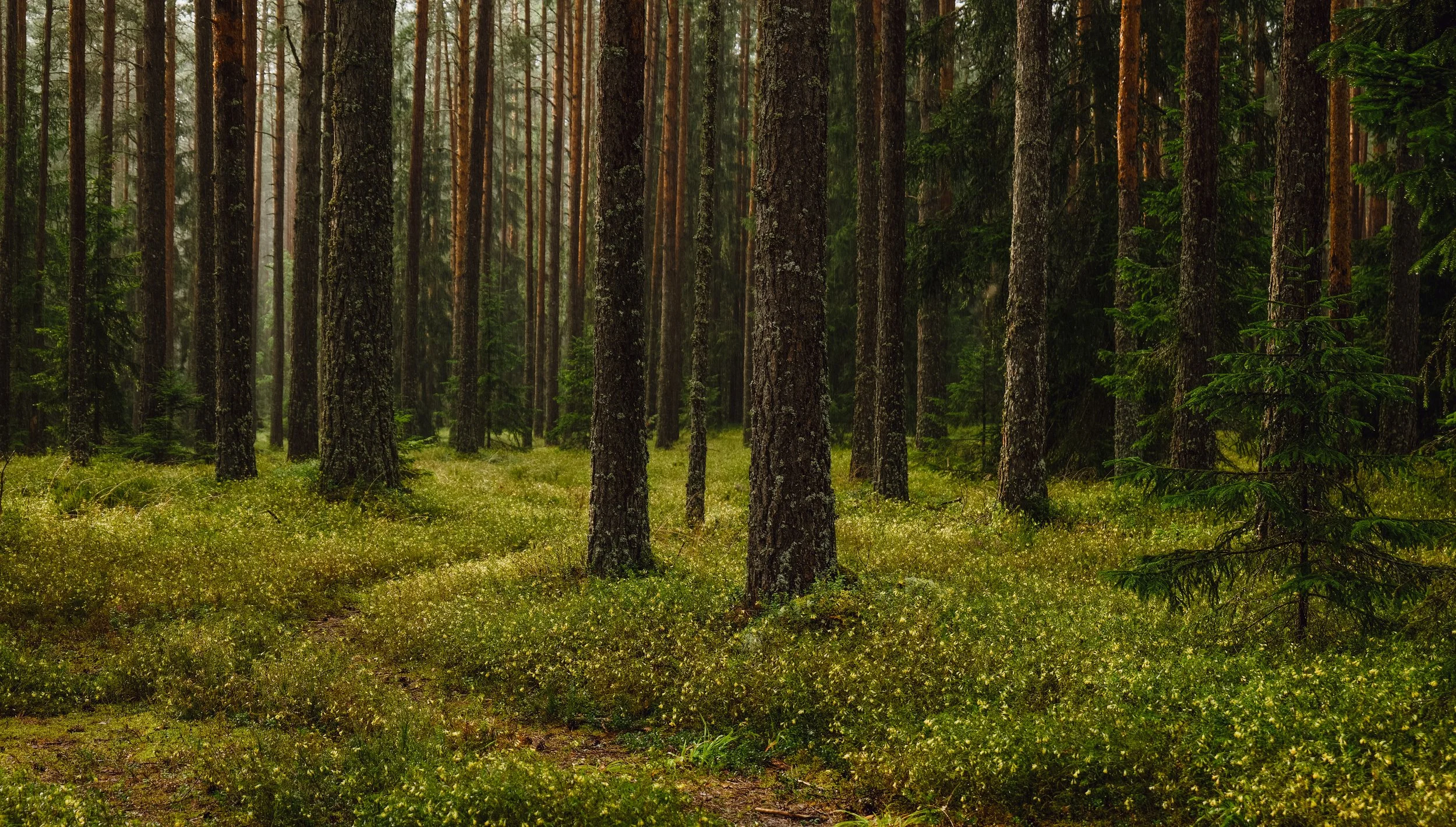
The trees stand tall and patient in the soft grey light. Their forms are mostly outlines, but their presence is certain. The forest floor holds the memory of night: damp leaves, scattered pine needles, and the faint, earthy scent of soil. Every step makes a gentle sound as your feet meet the soft ground.
Light begins to move slowly, brushing along the bark and slipping between branches. Shadows shift in response, stretching and softening at the edges. Every movement is careful, deliberate, as if the world is learning how to wake.
A bird calls once and stops. Silence follows, full of waiting, attentive but not demanding. Your body starts to settle on its own. Your breath deepens, your shoulders loosen, and your chest feels lighter. There is nothing to do except be here, quietly, with the moment.
The light grows higher, reaching the upper canopy. Pale green leaves catch it and release it in patches. Small openings reveal glimpses of sky, a muted blue with hints of silver. The forest does not demand anything from you. You do not need to interpret, to act, or to record. You simply exist within it.
Before the day has fully arrived, there is a moment when the world feels neither awake nor asleep. The dark loosens its hold just enough for the air to feel different. It is cooler, quieter, and somehow more spacious.
On the ground, small details emerge. Fallen leaves curl and flatten. Moss clings in shaded pockets. Stones reveal their shapes. A narrow path suggests itself and then disappears again beneath the forest debris. The light touches what it can and leaves the rest alone.
Time feels different here. Minutes stretch. Or maybe they just drift. Stillness isn’t the same as nothing moving. Leaves tremble. Branches sway with the breeze, lazy and unpredictable. Light slides across the forest floor. Shadows shift and pull themselves into new shapes. Nothing seems to be in a hurry.
You notice how this calm differs from the rest of the world. There is no urgency to eliminate darkness, to brighten shadows, or to control the day. The forest simply exists. The morning unfolds. You exist within it.
Your awareness spreads slowly outward. You hear the faint rustle of small creatures beneath the leaves. A squirrel moves somewhere above, quiet and careful. The wind brushes through distant branches. None of these sounds demand attention. They are part of the forest’s rhythm, a background that lets you breathe deeper and notice more.
You bend slightly to examine the earth. Small mushrooms peek through leaf litter. Tiny insects move across wet surfaces. Every detail seems purposeful in its simplicity. Nothing is frantic. Nothing is hurried. Even growth is patient.
The light starts to feel warmer on your face. It moves constantly, catching new angles and forming patterns that last only a few heartbeats. Shadows pull closer to the trunks that cast them. Darkness doesn’t disappear. It simply rearranges itself, finding a quiet balance.
You take a deep breath. You feel the air filling your lungs, cool and scented with earth. The forest reminds you that stillness is not a pause from life. It is a way to inhabit life differently. You carry your own rhythm, slower, softer, more observant.
A thin mist rises from the forest floor. It catches the light and makes the air itself feel visible. You watch it drift, swirling in small, unpredictable patterns. You notice how the forest is alive but not urgent. The light, the air, the leaves, and the shadows all move without haste.
Time continues, but it feels suspended. Your thoughts arrive and pass without effort. You do not chase them or push them away. You notice them as you notice the shifting light, the moving shadows, and the texture of the bark under your fingers.
Somewhere in the distance, another bird calls. This one lingers longer before silence returns. You hear the difference between the pause of the forest and the pause inside you. They feel connected. They resonate with one another.
You start moving slowly along the narrow path. Each step feels intentional. Your feet sink slightly into the damp soil. You notice the subtle changes underfoot, the rise and fall of stones and roots. Every step becomes a small act of mindfulness. Every pause between steps is a chance to see the light shift across the leaves.
Above, the canopy changes slowly as the morning moves forward. Patches of sky open wider. Shadows shift quietly. Sunlight catches on dewdrops, scattering tiny glimmers across the undergrowth. You stop to watch, letting your attention linger on these small, fleeting motions.
Return to the Present
Why the mind drifts and how coming back gently reshapes attention and presence.
Most of us move through the day with only partial awareness of where our attention actually is. Even in quiet moments the mind tends to wander, replaying conversations, imagining the future, or returning to unfinished tasks. This is not a flaw. Research on the brain’s default mode network shows that wandering is a natural activity, part of the mind’s baseline state. Evolutionarily it helped humans plan ahead, anticipate challenges, and integrate past experiences. Today, though, constant digital stimulation and multitasking make it harder to stay present.
Yet noticing that drift and choosing to return to the present can be surprisingly restorative. Studies of mindfulness and attention show that each gentle return strengthens focus, improves clarity, and supports emotional regulation. It is not about perfect concentration or forcing stillness. It is about creating a rhythm of noticing when attention slips and bringing it back again and again. Over time this simple act shapes how the mind manages distraction.
Returning to the present also affects the body. Paying attention to the breath, posture, or a simple sensory cue can calm the nervous system. Even small moments of awareness reduce tension, lower stress, and allow the mind to settle. Research in neuroscience and contemplative practice shows that these micro moments of presence help the brain respond more flexibly to stress and maintain clarity under pressure.
Cultivating this habit of returning creates a form of awareness that allows us to observe thoughts without judgment. It is the foundation of emotional resilience and cognitive focus. And it is accessible anywhere at any time. A breath, a touch, a sound, or a patch of light is enough to draw attention back. The rise and fall of the chest, the texture of a table under the fingers, the distant hum of a city, or the way light shifts across a room, these small cues can ground attention in the moment.
Presence is not a destination. It is a rhythm, a continuous practice of noticing and returning. Each return brings a little more clarity, calm, and grounding. It is not about escaping thought but about learning to inhabit the moment fully. Even simple gestures, the inhale of a breath, the warmth of sunlight on the skin, the quiet layering of sound around you, can become meaningful acts of returning.
The moment you are in is already here, waiting for your attention.
Spaces to Breathe
An introduction to immersive stories.
These immersive stories are an invitation to step out of the constant pull of daily life and settle into a quieter rhythm. They are meant to be experienced slowly, the way you might take in the atmosphere of a room, notice the weight of still air, or trace the shape of an object with your eyes. Each piece follows a single, unbroken thread of thought, offering you a current you can drift along without rushing or dividing your attention.
In a world that often demands instant reactions and scattered focus, giving yourself fully to one unfolding moment becomes a rare form of calm. These stories invite you into that state. Sometimes they carry you through open landscapes. Other times they guide you into an interior space, a quiet corner, a subtle detail, or an ordinary object made luminous by the act of noticing. Whatever the setting, each story is designed to soften the noise around you and give your mind permission to settle.
Digital immersion is often associated with overload, but with intention it can become a doorway back to presence. When the imagery is unhurried, when the language moves gently, when the focus narrows to something simple and grounded, even a screen can become a place to breathe again. These stories are crafted to offer that shift. They pull your attention inward, open a bit of internal space, and remind you of the steadiness that appears when your mind is allowed to rest.
Think of each story as a small retreat. A moment of clarity contained within a few paragraphs. A pause that gathers your senses. A place where your attention becomes whole again and you can inhabit the quiet ease of a single continuous flow.
This series exists for those moments. To help you slow down. To help you return to yourself. To offer gentle immersion into stillness, no matter where you are.
And to begin this journey, our first story will take you into the desert, a vast, quiet landscape where open space meets the stillness of the mind. It is a place of immensity and reflection, the perfect setting to begin exploring the flow of attentive calm that each immersive story in this series will offer.
The Noise and the Stillness
In a world that won't stop, what happens when you pause?
We live in a world that never seems to pause. Notifications ping, headlines scream, meetings stretch, emails multiply. Even our moments of rest are filled with the hum of a phone, the low buzz of a laptop, or the constant chatter of our own minds. Noise surrounds us not just in sound, but in thought. The endless internal noise of to-do lists, worries, and reminders that we are never doing enough can be just as loud as anything outside. Sometimes it feels like our own thoughts are racing faster than the world around us.
And yet, there is another world quietly waiting beneath all of it. A world of stillness. It doesn’t shout or demand attention. It just exists, waiting for us to notice, to lean into it, to breathe.
Noise keeps us sharp and reactive, but it also scatters us. Internal noise pulls our attention in a hundred directions at once. Stillness lets us settle. It is in the quiet that thoughts organize themselves, that hearts soften, and that creativity begins to grow. In silence, the constant mental chatter begins to fade, and we can hear ourselves again without interruption or expectation.
Think about the last time you truly paused.
Not the pause in traffic or while waiting in line. Not the pause while scrolling through social media, pretending you are resting while your mind races with everything you should be doing.
I mean the kind of pause where you set your phone aside, close your laptop, and just exist. Just you, your breath, and the subtle rhythms of life moving all around you. In that moment, the internal noise might still whisper, but it becomes something you notice rather than something that controls you.
In stillness, the world does not disappear. The noise is still there, both outside and inside. But something shifts inside you. You become a witness rather than a participant, an observer rather than a reactor. And in that quiet observation something precious happens. You gain perspective. You find clarity. You feel a sense of peace.
We have forgotten the art of resting and with it the ability to hear the gentle hum beneath the chaos.
Today, pause.
Close your eyes, take a deep breath, and notice the stillness around you.
Let it remind you that not every moment needs to be filled, and not every thought needs attention. Let the noise exist without letting it define you.
In a world that won’t stop, pausing might just be the most radical thing you can do.
Welcome to ÆRTHIA
A Quiet Sanctuary in a Loud World.
There’s a certain kind of quiet we don’t find much anymore. The kind that isn’t empty but full of breath, space, and calm.
ÆRTHIA was created for that quiet.
It is a digital sanctuary for the mind, a place to pause, breathe, and come back to yourself in a world that rarely slows down.
We live surrounded by noise. Notifications, headlines, messages, constant motion. Even the moments meant for rest arrive through a glowing screen. But what if the screen could become a place of peace instead, a window not a wall?
ÆRTHIA is our answer to that question. Here, technology becomes a tool for stillness rather than stimulation. Through meditative visuals, ambient videos, and minimal poetic affirmations, we craft experiences designed to calm the senses and restore balance.
Each piece is shaped by the rhythm of nature, the gentle pulse of light through leaves, the tide’s slow return, the morning hush of the forest. We draw inspiration from the world outside our devices and bring that beauty into the digital space, where it can meet you wherever you are.
ÆRTHIA is more than imagery; it’s a shift in intention. It’s about turning your time online into something softer. It’s about making space for stillness, for curiosity, for rest.
Over the coming months, you’ll find here:
Visual retreats and loopable films for moments of pause
Gentle affirmations to anchor your attention
Reflections on digital calm and mindful design
Landscapes that move, breathe, and unfold like nature itself
Each piece is an invitation to slow down and reconnect with the present moment, even if just for a few minutes.
This is only the beginning. ÆRTHIA will grow into a constellation of calm, a digital ecosystem dedicated to your restoration and sensory balance.
For now, I invite you to take a deep breath.
Let your shoulders drop.
Let your mind rest here, in the stillness between sound and light.
Welcome to ÆRTHIA. A digital place to rest, recover, and remember what it feels like to simply be.
We’re so glad you’re here.